

we have gathered inspiration that supports the four key areas: imagination, play, fine motor skills and concentration. Ready to dive into whenever the moment feels right.


How to prepare your child for starting school
Starting school is one of the first major transitions in a child’s life – both for your child and for you as a parent. A school bag can be packed in an afternoon, but how do you prepare your child for the new beginning that lies ahead? Doctor, author and artist Lærke Egefjord shares her insights on how you can support your child through this exciting new chapter without adding unnecessary pressure.
For many families, starting school is something that takes up a lot of space in the months leading up to the first day. Your child may be counting down. Questions may already be beginning to surface: Who will I sit next to? What will the classroom look like? And as a parent, you may find yourself balancing pride, anticipation and care. Because starting school is not just a new routine. It is also an emotional transition.
Most of us know how to handle the practical preparations: a new school bag, a pencil case and a lunchbox with a name on it. But when it comes to the feelings and personal qualities that this new chapter requires, it often becomes less clear how to prepare. What should my child be able to do – and how do they find the confidence to step into something new?
Starting school is about more than letters and numbers
For doctor and artist Lærke Egefjord, this kind of preparation is an important focus. From her perspective, children do not need to be trained for school. Through play and creative activities, they can naturally develop important skills that help them feel ready for the transition:


Creative activities can be a gentle way to support children in the time leading up to starting school. These are small moments that make a big difference.
- Lærke Egefjord
This does not mean that children need to be able to do everything in advance. On the contrary, school is exactly where they are meant to learn and grow. But the transition can feel more secure if children already have experience with immersing themselves in an activity, asking for help and trusting their own abilities.
This is why creativity is more than just entertainment. When children draw, shape, cut, build and decorate, they are also developing key skills while experiencing the feeling: “I can do this.” They are engaged in a process where there is room to explore, experiment and change direction along the way. And that is an important experience to bring into school life.

Creativity strengthens your childs self-confidence, because it allows them to experience a sense of mastery and success through creative immersion.
- Lærke Egefjord

Immersion in a creative process activates a specific network in the brain called the Default Mode Network (DMN). When this network is active, connections are formed between distant parts of the brain, strengthening both memory and the ability to generate new ideas. This is why the ability to immerse oneself is so beneficial for both children and adults.
Doctor and artist Laerke Egefjord.
Four key skills your child can develop through creativity and play
According to Lærke Egefjord, creative activities support your child’s mental and social readiness by activating different areas of the brain. Many creative activities involve repetitive movements, which help calm the brain, heart and nervous system. That is why it is not important to “cover” lots of school preparation. What matters is that your child experiences calmness, presence and immersion.

Fine motor skills
Small movements that make a big difference
In the lead-up to starting school, it can be helpful to strengthen fine motor skills through peaceful, repetitive activities. Let your child draw, colour, cut out shapes or create bead designs. These activities help them learn to hold a pencil, control small movements more precisely and improve hand-eye coordination. At the same time, tools like pencils and scissors become familiar and comfortable to use.

Imagination
The freedom to think independently
Imagination is an important part of your child’s development. Open-ended activities without a correct answer support the ability to generate ideas, tell stories and think independently. This could be anything from drawing imaginative creatures to modelling playful figures. While your child is having fun, they are also practising trusting their own choices – a valuable strength when entering new social settings and facing new tasks.

Concentration
Staying with something a little longer
Many parents wonder whether their child will be able to “sit still” once school begins. Instead, it can be helpful to explore activities that encourage focus and immersion. Find something that truly engages your child and allow them the time they need. They get to explore, solve problems and perhaps even wait for something to dry before continuing. These small experiences gradually build patience and strengthen their ability to concentrate.

Play
When creativity comes to life
One of the most beautiful aspects of creative activities is that they do not necessarily end when the child has finished making something. A figure can become a character, and a mask can turn into the beginning of a role play. Play itself supports development, and when children play with something they have created, it adds an extra dimension. They are not just participating in play - they are shaping it. This can strengthen both independence and engagement.


How to use creativity in the time leading up to starting school
It does not have to be elaborate, planned or time-consuming. In fact, small creative moments in everyday life can be the most meaningful. Whether you draw, colour or explore simple creative projects together, you are already supporting the kind of development that school life involves. No one is expected to master everything from day one - and learning is allowed to take time.
So, enjoy preparing the school bag. Not just with a pencil case and lunchbox, but with all the qualities and abilities your child already carries within them. Starting school marks the beginning of something new - something exciting, significant and perhaps a little overwhelming. But through small, everyday moments of creativity and presence, you have already helped your child approach this new chapter with a little more calmness, a little more curiosity and a little more confidence.
If you are looking for creative ideas to explore in the time leading up to starting school..


Get ready for starting school – with advice from a doctor
How do you prepare your child for starting school? What do you need to have in place – and how do you know if your child is ready?
In this article, you will find helpful advice and clear answers to some of the questions many parents have in the time leading up to starting school. You will gain insight into how you can support your child through the transition into a new everyday routine, both practically and emotionally.
From school bag to self-confidence
The article offers inspiration on how to approach starting school in a way that is not about “training” your child, but about creating positive experiences and strengthening their confidence. Based on both everyday situations and professional insights, you will discover how creativity can become a natural part of the preparation.
You most likely already have the practical things in place for the new routine, such as a school bag and pencil case. Instead, we guide you on how to fill the space with meaningful experiences that help your child find calm in the new chapter they are about to begin.
Get ready for the first day of school
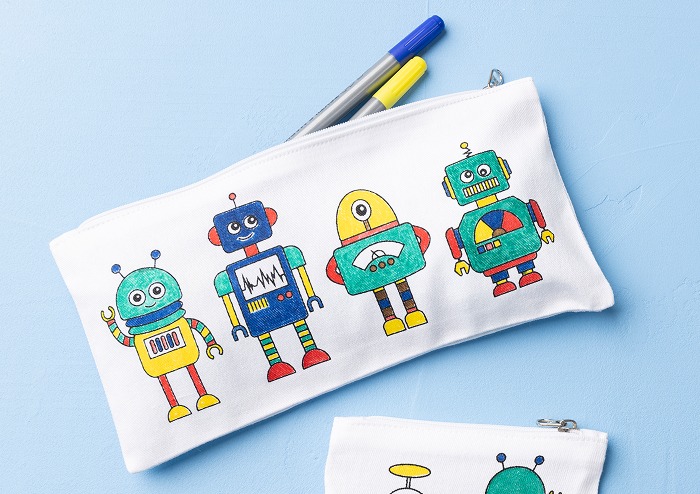
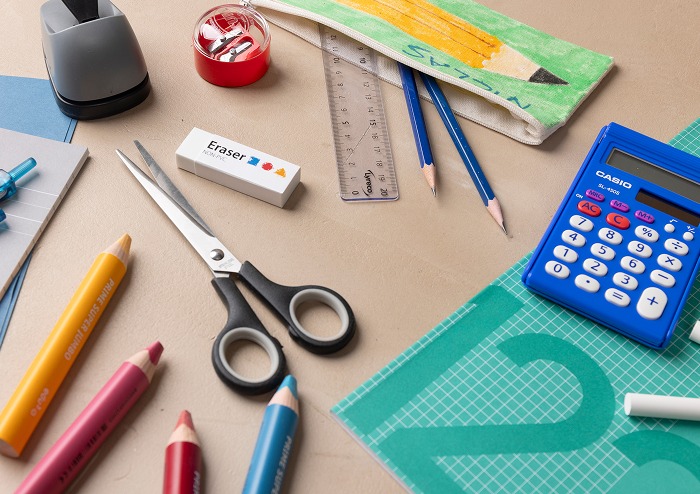
We have also gathered concrete ideas for creative activities that you can easily enjoy together as part of calm moments in everyday life. And of course, you will also find all the essentials for starting school, such as pencils, erasers and sharpeners – as well as more playful materials like textiles to decorate, so you can create a personalised pencil case, a gym bag or a pair of fun socks for the first day of school.
